New Publication: Towards Optimum Reporting of Pulmonary Effectiveness Databases and Outcomes (TORPEDO)

Towards Optimum Reporting of Pulmonary Effectiveness Databases and Outcomes (TORPEDO): identifying a core dataset for asthma and COPD studies

TORPEDO (Towards Optimum Reporting of Pulmonary Effectiveness Databases and Outcomes) was a collaborative project between the Global Alliance for Chronic Disease (GACD) and the Respiratory Effectiveness Group (REG). The study used a modified Delphi design to develop checklists of the optimum and minimum required variables for asthma and chronic obstructive pulmonary disease (COPD) research studies.

Initially a panel of 22 REG experts generated a list of 224 variables they considered optimum for respiratory studies. In phase 2 a panel of 64 participants from across the GACD and REG networks completed an online survey to select the minimum variables that they felt were required for any respiratory study. In the final phase 34 members of the panel completed voting to select a set of minimum variables required for specific study designs.

The panel reached a consensus on 13 variables for retrospective asthma studies and 34 for prospective asthma studies. For COPD studies, 16 variables were selected for retrospective studies and 37 for prospective studies. Gender, exacerbations and patient-reported outcomes were the only variables with 100% agreement for both asthma and COPD studies.

The proposed list of minimally required variables generated by this research will aid the assessment of current data sources for their utility in asthma and COPD studies and standardization of data collection. This will improve research efficiency, replicability and transparency and facilitate the sharing, merging and comparison of datasets.

https://doi.org/10.1101/2021.10.14.21264843


New REG Publication: Childhood asthma outcomes during the COVID‐19 pandemic

Childhood asthma outcomes during the COVID‐19 pandemic: Findings from the PeARL multinational cohort

Members of the Paediatric Asthma in Real Life (PeARL) think tank initiative have recently published a paper showing a positive impact of the COVID-19 pandemic on childhood asthma.

The study included 1,054 children with asthma and 505 non-asthmatic control subjects, from 25 paediatric departments across 15 countries. During the pandemic children with asthma had no increase in risk of episodes of pyrexia, lower respiratory tract infections, emergency department visits or hospitalisations for any reason, compared to those children without asthma.

Furthermore, in comparison to the previous year children with asthma had fewer upper respiratory tract infections, episodes of pyrexia, emergency visits and hospital admissions for any reason, asthma attacks and hospitalisation due to asthma. Two thirds of the children had improved asthma control, with 33.2% having an improvement that exceeded the minimally clinically important difference. Lung function measures were also improved during the pandemic.

It is predicted that the improvements seen are the result of social distancing, home sheltering and reduced school attendance, which have reduced exposure to asthma triggers (e.g., outdoor allergens, viral infections, physical exercise and air pollution). Increased medication adherence may have also played a role; indeed, self-reports of adherence were increased in the study population during the pandemic.

These data do not support the hypothesis that childhood asthma is a risk factor for COVID-19. Importantly, they highlight the potential to improve childhood asthma outcomes through environmental control, e.g., wearing of masks.

https://doi.org/10.1111/all.14787


New REG Publication – A real-life comparative effectiveness study in asthma exacerbations in primary care

A real-life comparative effectiveness study into the addition of antibiotics to the management of asthma exacerbations in primary care

A comparative effectiveness study utilising historic electronic medical records from the Optimum Patient Care Research Database (opcrd.co.uk) was conducted to assess the effectiveness of the addition of antibiotics alongside oral corticosteroids for treating asthma exacerbations. The results of this study by the REG Child Health Working Group have been published in the European Respiratory Journal.

The study highlights a high level of antibiotic prescribing in relation to asthma exacerbations, despite this being contrary to guideline recommendations.

Previous randomised controlled trial data has suggested a potentially beneficial effect of antibiotics, in particular macrolides, in asthma exacerbations treated in secondary care. In the large heterogeneous primary care population in this study the use of antibiotics alongside oral corticosteroids for treating asthma exacerbations was associated with a small reduced risk of having a further respiratory consultation in the following two weeks, compared to oral corticosteroids alone. This small effect was seen in those prescribed penicillins, but not in those prescribed macrolides.

Given the small magnitude of the effect and considering the risk of side effects, the cost and most importantly risk of antibiotic resistance associated with the addition of antibiotics it was concluded that the routine addition of antibiotics to oral corticosteroids for the management of asthma exacerbations appears to confer little clinical benefit.

https://erj.ersjournals.com/content/early/2020/12/10/13993003.03599-2020


New REG Publication in Real Life COPD

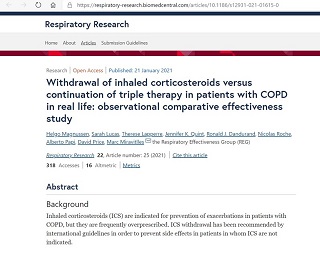
Withdrawal of inhaled corticosteroids versus continuation of triple therapy in patients with COPD in real life

In patients with COPD inhaled corticosteroids (ICS) are indicated to prevent exacerbations, but they are frequently overprescribed, and withdrawal of ICS is recommended by international guidelines to prevent side effects in patients where ICS is not indicated.

Utilising real-world primary care data from the UK’s Optimum Patient Care Research Database (OPCRD) members of REG’s COPD Working Group have conducted a comparative effectiveness study to assess the effect of ICS withdrawal versus continuation on triple therapy in patients with COPD.

In the primary care population included in this study, composed mostly of infrequent exacerbators, cessation of ICS in patients on triple therapy was not associated with an increased risk of having an exacerbation. However, the subgroup of patients who experience more frequent exacerbations and have high blood eosinophil counts should not have ICS withdrawn.

The results of this study have been published in Respiratory Research -

https://doi.org/10.1186/s12931-021-01615-0


REG Press Release on new publication: Face masks, respiratory patients and COVID-19

REG PRESS RELEASE:

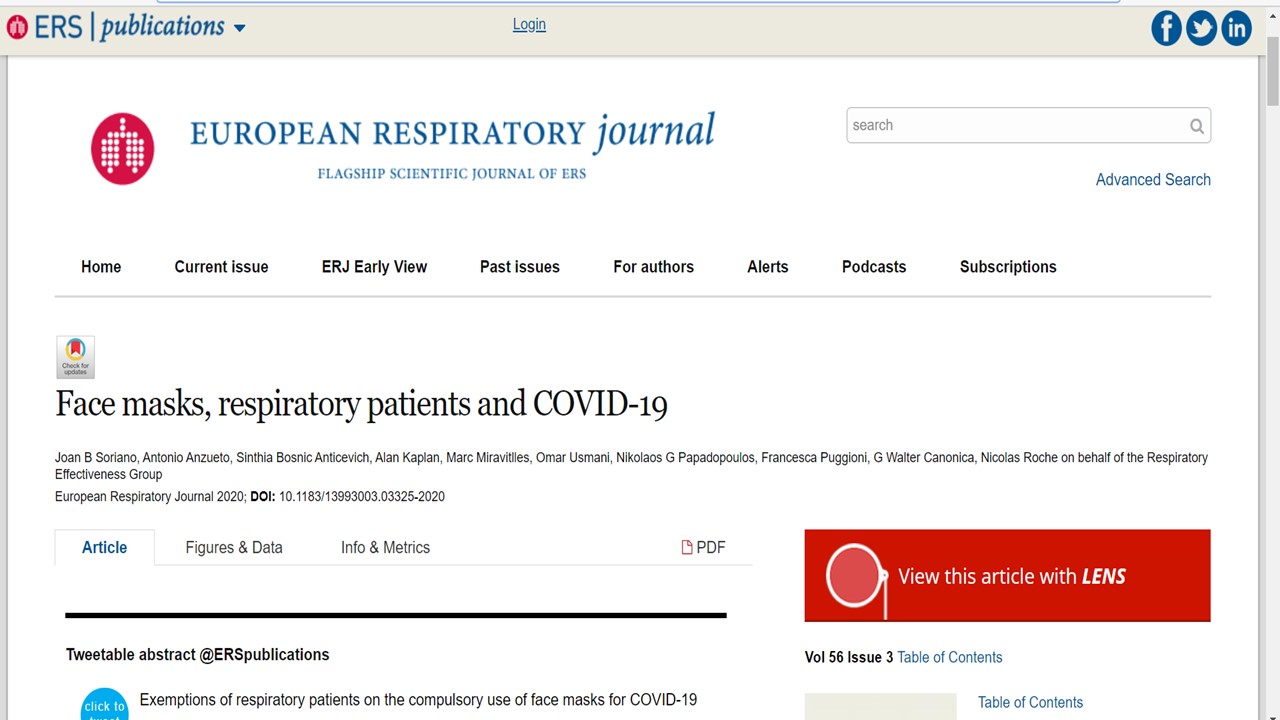
Exemptions of respiratory patients to use face masks are not evidence-based, and it may carry associated risks of severe COVID-19

There have been many false health news, hoaxes and biased information about the ongoing COVID-19 pandemic circulating on the net, and also in printed media and on TV. However, sometimes confusion and misinformation occur through official channels. And it can have serious consequences.

One of them is the exemption for respiratory patients to use a facemask, mandatory elsewhere for everyone both in shared outdoor and indoor spaces since May 2020. The Spanish and British laws state: "Those persons who present some type of respiratory difficulty that may be aggravated by the use of the mask, and those whose use is contraindicated for health or disability reasons, are excepted from this obligation."

At the Respiratory Effectiveness Group (REG at https://www.regresearchnetwork.org/), an independent global group of medical doctors and researchers in Spain, the United Kingdom and many of the EU member states, the United States, Canada and Australia, among others, have reviewed the available evidence.

In an article published today in the European Respiratory Journal (accessible from https://doi.org/10.1183/13993003.03325-2020), one of the most prestigious international journals in the respiratory arena, it was concluded that there is no evidence to support this exception, and that patients with a respiratory disease are at a high risk of suffering severe COVID-19, in Spain, the UK and elsewhere. We must succeed in eliminating this exception.

Dr Joan B Soriano, medical epidemiologist at the Respiratory Dept. of Hospital La Princesa in Madrid, Spain, member of the WHO COVID-19 Clinical Network Knowledge Exchange Team, and primary author stated: “Patients with asthma, COPD or other respiratory diseases should wear the mask without exceptions. If they have respiratory failure or with a feeling of shortness of breath when putting it on, they should most likely limit their activity, especially outdoors.”

Not using a mask to avoid an asthma attack, or exacerbations of COPD, or of other respiratory diseases, due to an alleged increase in inspiratory pressures through a mask, is unfounded.

Professor Sinthia Bosnic-Anticevich, from the Woolcock Institute at The University of Sydney, who is President of REG and also co-author, also stated: “Please, if you or a relative of yours, have asthma, COPD or other chronic respiratory disease, wear a mask to protect yourself and others. This is a new virus and a new disease, but clear information and individual decisions are critical to defeating this pandemic.”

It is estimated there are 545 million people worldwide suffering a chronic respiratory disease, and not wearing a face mask may carry increased risk of personal and group infection.

Publication citation:

Soriano JB, Anzueto A, Bosnic Anticevich S, et al. Face masks, respiratory patients and COVID-19. Eur Respir J 2020; in press

Online from Tuesday 29th September 2020 08:00AM GMT

https://erj.ersjournals.com/content/early/2020/09/09/13993003.03325-2020